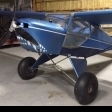
Bringing a Kitfox 1 back to life

229 posts in this topic

Posted


And if I'm not mistaken you can legally take lessons in your own plane with dual set up.

Yes of course you can.  You can do it without having dual brakes as well but it is not the smartest thing to do.


Share this post


Link to post
Share on other sites

Posted

That is exactly the reason I bought it, and it is finally working out for me. I actually got to fly it for myself, today (with the instructor). It was as great as I hoped it would be. Took a bit longer than I planned, but I should be able to get my license before fishing season. I work year round, but summers are especially busy. The plane was great. Beautiful day. Warmed up to the 20s, clear and calm. Last time we flew, I was sitting right seat, hands off, ducking around that cross bar. There was also a strong crosswind, that day. 

2 people like this

Share this post


Link to post
Share on other sites

Posted

I did the dual brake upgrade, not cheap. Then my jet pilot CFI drove us off the runway thru a ditch into the weeds coming in too hot. Caught his big ass boot on a tube, never said a word. I stomped so hard and saved the loop but it cost me a bent Grove spring gear too... 

Share this post


Link to post
Share on other sites

Posted

I noticed that the tubing is kind of in the copilot's way, especially the pull-starter tube by his left rudder pedal. I don't have any big issues from the left seat, but I noticed right away that there was less room on the right side, and mentioned it to my instructor. My foot got jammed in there in the first minute of testing, with ordinary shoes. Need to keep that left foot toward the right side of the pedal. The copilot also has to deal with the crossbar that angles across the cockpit, right where the top of his head should be. 

Share this post


Link to post
Share on other sites

Posted

Same in the Avid. I cut that pull start handle/rope guide off my Mk-IV for right side brake pedal clearance.

image.jpeg

image.jpeg

Share this post


Link to post
Share on other sites

Posted

Had some good company next door, today. Nice 801.

579B79F6-51E3-4D7B-B64F-98F75B6EA74B.jpeg

Share this post


Link to post
Share on other sites

Posted

Old #29 has been good to me. I have about 75 hours on the Hobbs, since getting her back in the air. It was time to reset the point gap, since timing was nearing the lower end of the range. Since I had it in the shop, with the engine off, I decided to install the wing tanks, replace the windshield, and lengthen the tail feathers. Horizontal stabilizer got angled down as much I could. Four inches added to the chord of the rudder and elevator. I made some flapperon end caps to fix up the inside ends, which were torn up a little from folding the wings, and were slightly loose. They are very solid now. 

6CD8FB73-3579-4314-8E78-958557A56158.jpeg

9F60B320-D632-4595-9A49-39F48B89B67C.jpeg

E53F251D-722C-43C3-881F-DEE6DA5B124E.jpeg

52CC8AC3-2723-4CEA-A8F8-4C029E8AA549.jpeg

3B95129D-76C3-475E-A8B8-BEEC68D2AF34.jpeg

1B9802F3-01E4-44D3-8FEF-43200956D57A.jpeg

05A8C5A0-F5A0-490C-8617-EA859A313586.jpeg

B437665A-E5E2-44A7-81BE-176D8F89DD12.jpeg

CD679A40-A4E0-4DF3-B43B-CF781979B7A5.jpeg

03B7430D-3626-43CE-A20B-B47AF6BDAD59.jpeg

C0461E43-01EF-438F-AC59-365E14CFDA91.jpeg

B804119D-6332-4A62-A3AC-674E3C8326FA.jpeg

1ECE680E-E8FD-44C0-BE91-1C5E00ADC7A8.jpeg

1 person likes this

Share this post


Link to post
Share on other sites

Posted


she will be even better to you after all those mods. Maybe a bit heavier ha but thats ok.

Share this post


Link to post
Share on other sites

Posted

Yes, the wing tanks added 27 pounds, but I can live with that. It's closer to 25, considering the parts I removed from the wings to fit the tanks. That's the same weight difference between the 25" tires and the 8.00s. I'm putting the small ones back on, so it will be the same weight as when I last flew it. Until I top off the tanks, anyway. But that extra six hours, or more, added to the range, will be very nice. My next project will be to put it on the skis. But first, finish this and get flying again. 

Share this post


Link to post
Share on other sites

Posted

After I did most of my flight training in the Kitfox, it was good to hear that the DPE was willing to do the check ride in it. He came close to calling it off when we had communication issues, but he toughed it out and I walked away with my PPL. My instructor and I have had a finger of an insulated leather glove stuck over our mics since February, and I didn’t remember to suggest that to the examiner on the big day, which meant his mic was picking up a lot of noise. A LOT of noise. I had to back off the throttle significantly to be able to hear him clearly. All’s well that ends well. He did say it wasn’t the best choice for a check ride, but it was a pretty good ride, all things considered. It’s been a long-time ambition of mine to get my license. Onward and upward. 

66B11522-7B08-4124-BB6D-853A2DAEF72A.jpeg

4 people like this

Share this post


Link to post
Share on other sites

Posted

I finally got my Federal 1500 skis rigged. It has been incredible ski flying around here, lately. 

592263AA-EE66-420F-8E92-5C925F8C761D.jpeg

9909F6B2-AD99-4E08-B1FE-6AFDBD83B9D4.jpeg

255407F4-2498-4F12-970D-5E22BDB0DF75.jpeg

C9873C81-9DB9-45A5-9640-806A59E72830.jpeg

81CD93DB-ED13-495A-9BC7-15DAFEB8C88E.jpeg

2 people like this

Share this post


Link to post
Share on other sites

Posted

Pretty nice.  I love ski flying as well.  Flew on wheels last evening for the first time since December something....  The last two pictures must have been on your trip to the south pole??:lmao:  JImChuk

1 person likes this

Share this post


Link to post
Share on other sites

Posted

Will this rain ever stop?
I flew for a couple hours this morning. It sure was nice. I should have taken pictures, but I kept the doors closed and just enjoyed the flight. I have a flight review due soon, so I went through a bunch of stalls, S turns, slow flight, and other maneuvers, maintaining steady altitude. The flight was followed with the hard slip and soft three point that my short field requires. The field has some bumps, so the landing isn’t always as soft as it was today. It’s always really satisfying to grease it in there like that. 91299FC2-D525-45D6-814E-EE366DC7E428.thuLast winter, I made some adjustment to my flaps. I had found that the plane would fly level, without stick pressure, with the flap lever pulled up about an inch. Typical thing that many Kitfox owners do to trim the plane’s pitch. I figured that was just wasting a few degrees of flap, and adjusted it to fly level with the flaps up all the way. That is, with the lever down as far as it will go, the plane is trimmed in flight. As a side note, I had first needed to adjust the angle of the horizontal stabilizer in order to be able to trim it and not need forward stick pressure. With the flap adjustment, I got it close, but need just a hair of back pressure now. 
I’ve been debating whether to make that last bit of adjustment by moving the flaps back up slightly, decreasing the total down angle with full flaps, or by moving the front of the horizontal stabilizer back down. I did see a slightly lower stall speed after the flap adjustment. 
After my morning flight, I decided to check the flap angle, along with the angles of the wings and horizontal stabilizer. With the plane sitting on 25” mains, on the relatively flat ground, I used the handy level feature of my iPhone to check the angles. I used a straightedge from leading edge to trailing edge of the wings, checking the angle at root and tip, as well as measuring the angle of the flat-bottomed flaperons while “flaps” were down, then up, and also checked the angle of the horizontal stabilizer, and the floor, which is used to determine level for weight and balance. CA0F8585-6BC2-4B9C-B75F-3D0A6FA21C80.thu
With the flaps down, and both flaperons at the same angle, flaps were at 26°. Note that 26° is not the flap angle, in regard to wings or angle of incidence, as the plane had all three wheels on the ground. 
9A144468-3317-469A-8F2C-CE7CE91933CE.thuWith flaps up, both sides showed 9°. This is a difference of 17°. Full flaps = 17°. I wonder how much less flap angle there was before my last adjustment. Maybe 2°-3°? 20% less?

2A0FA41D-69E2-4544-B937-4A5866010F54.thu
Full flaperon deflection netted a range of 8° to 50°, with the flaps down. That’s 42° total up to down on flaperons. That 8° is only 1° more than the wingtips, or 6° up at the root. I hadn’t considered previously, that the flaperons move up relatively less at the wingtip, due to wing twist. It has 18° up, and 24° down. It should be the other way around. Everything about it is in favor of adverse yaw.

DFA4BBD9-BFD1-4A07-BDB8-63CA9E71B109.thuThe wingtips showed the same 9° as the flaperons, flapped up. Both wings had the same angles for root and tip. The angle at the last rib was the same as the droop tip.

04290DE5-FFC2-4CA5-B457-9C5284E94A3C.thu
Wing roots showed 14°. That’s 5° of twist, root to tip. The floor was the same angle, 14°.

60CCFFDD-38A3-4004-8973-EA8DC05ACEEF.thuThe horizontal stabilizer was at 11°.

While I concluded several things from this, I’d love to hear any input you might have. 

First, let’s put in perspective. Obviously, it won’t fly a steady altitude with the floor level. The root would have zero AOA, and wingtips would be minus 5°. Flaperons would likewise be reflexed to -5°, while the horizontal stabilizer would be at -3°. I’ve often thought it could use a bit more angle of incidence. But, the floor is just a reference, anyway. A flat plane, if you will, that’s easy to level.

Ignoring all that, I think I ought to give it another 1° to 3° of flap, and put the horizontal back to its original position. Doing that would put the flaps, while retracted, at approximately the same angle as the bottom of the wing, while also increasing the total angle of the flaps, extended. That would be the same angle as the middle of the wing, rather than the tip.

I believe that this would make it more efficient inflight, as the flaperons, wings, horizontal, and elevator would not be fighting each other as much.

My wife shoots video of most of my takeoffs and landings, here at the house. Today’s video of the landing showed that the tailwheel stayed off the ground while I had the stick back a good bit. I don’t believe that I was hard on the brakes, if at all. My usual routine is to keep the tail up, after I touch down, so the tailwheel isn’t eating the bumps, and let it roll out. Balance would have been neutral or slightly aft, with just a few gallons in the panel tank, and wing tanks empty. 
https://youtu.be/p_64N6ywJDo

On the negative side, it would have about zero up aileron, at least at the wingtip, with flaps deflected. I’m not sure if it could have much more adverse yaw than it currently does, but the rudder works just fine. One more thing, that might become an issue, if it’s not already, is that the flaps might not fold up flat enough when the wings are folded back. I had considered that that was the reason for that geometry, in the first place. If I ever need another project, I could convert to differential control, but I’m not planning to do that, at this point in time. I like the ease of folding the wings back, without disconnecting anything, even if I hardly do it anymore  

I wouldn’t think there’s any benefit to taking the flaps back up. The ailerons don’t go up any further, at least, not if it’s trimmed to fly without stick pressure. I don’t have a stopper for the flap lever. It stops against the torque tube for the sticks. I’ve read the old concerns about control reversal and the need to limit flap travel, but never experienced anything like it, with about 275 hours and lots of full flap landings. Maybe that was first flight nervousness by those unfamiliar with the amount of adverse yaw, and they mistook the effect. 

Here are the stats, simplified, as with the floor leveled:

Angle of incidence, wings, average: -2.5°

Range of motion, flaps: 17°

Range of motion, ailerons: -18°/+24°; 42° total

Angle of incidence, stabilizer: -3°

Is it ever going to stop raining? Look what it’s done to me. I hope you’re all enjoying your Kitfox, whether working on it, flying it, or just considering its different angles.
 

Matt

8B6E128B-DD20-411F-B50F-0C7C2532924F.png

B62AB8F3-FCC5-48E3-B1B5-E5C9D7C2C690.jpeg

1 person likes this

Share this post


Link to post
Share on other sites

Posted

For what is probably the first time since August, 2018, I don’t have any pictures or videos of the plane, or taken while flying it, currently on my phone. I had to turn to the forum to get a look at it. 
 

It’s been just over six years since I bought it, almost five since it passed the first condition inspection, and almost four years since I took my check ride in it. It’s a little worse for wear, having put 400 hours on the meter, which quit ticking during a recent flight. 
 

That flight was on Friday, September 13. A few minutes after takeoff, I got a text, asking prayers for a friend who had just set off the ELT in his Citabria, while spotting moose with his brother. That’s about the time the clock stopped. 
 

It was a beautiful flight. I canceled my flight plan and flew the hills, because I had to. Then, feeling a sense of peace, I continued with my planned flight. It was a beautiful day. 
 

A couple hours into my long flight, I got another text, confirming what I already knew.
 

The pilot was a lifelong friend. His kids are my age. He bought the plane with his dad, back in the 70’s, and kept it well-maintained. I got two of my horses from him, and he officiated at my wedding. I helped set the trusses on his hangar, some years back, when he built the Lowell Field Airpark. That was named for Norman Lowell Smith, the prestigious local artist, and another old friend, who’d passed away about a week before this. When he heard I got the Kitfox, he was quick to offer me the option of using the strip, which I have made good use of.

That morning, as I fenced in the horse, and smelled the good hay I’d bought from him, I felt some real admiration for that good man, and considered how much he accomplished, while criticizing myself for not doing half the things I need to. I thought about calling, just to say that. 
 

So, friends, live your lives. We all die. Whether as the blind painter lives out his days, or the great hunter stalls at low altitude, we all go. Don’t be afraid to live the life you want, fearing failure, or thinking you’ll avoid the inevitable. Have faith in God, do what’s good, and change when you realize your faults. 
 

While I might not have pics of good ol’ #29, here’s a good one to share with you.  IMG_1147.webp


IMG_1147.webp

1 person likes this

Share this post


Link to post
Share on other sites

Posted

Hi Matt,   It sure is sad for sure when time runs out for friends, and we know it will for us as well.  I'm helping a friend's widow sell off a bunch of aircraft stuff now as a favor to them.  I know my wife will have a time with all my aircraft stuff at some point in the future.  She has no idea of all the stuff and what it's worth.  I did manage to put a bit more than an hr in the log book with the Kitfox today, so trying to enjoy what I can.   Some good suggestions you gave near the end of your post!  Thanks,  JImChuk

Share this post


Link to post
Share on other sites

Posted

The old 503 finally gave up, 41 years after it was built. I had already planned on doing the upgrade to the Simonini Victor 2, and the interesting end of the 503 means there is no reason to put it off any longer.

IMG_5981.thumb.jpeg.66cf32788295f5b92739 
IMG_5979.thumb.jpeg.c1a85777bb4e7fc29073

The Victor 2, sitting on Simonini's aluminum mount and "silent blocks", put the prop flange at the exact same height as the 503, on its original aluminum bed mount for the Kitfox. The carbs, exhaust, starter, and engine mounting plate weren't going to clear the old engine mount, so I set about welding up a new one. I wanted to keep the original fwf and engine, so it can always go back to its original form. 
IMG_6210.thumb.jpeg.4b732c412d34ba85b100

The Victor 2 is bigger and heavier than the 503. It's about 2" longer, and an inch taller, to the top of the spark plug caps, as compared to a 582 with a C box. That is not counting the 582 starter, and relocating the coils from the back of the Simonini. I already had the 503 apart, so I didn't get dimensions on its height. It's a pull-start. 
IMG_6199.thumb.jpeg.cc9aeeb231f6eda400f5

The model 1 through model 4 1200 have the same engine mount locations on the airframe. Interestingly, the footwells on the model 1 are wider than on the model 4. The space between the footwells, on the firewall, is about an inch narrower on the model 1. The footwells stick out into the engine compartment the same distance, at the same angle. 
 

As is, I left the coils on the Victor 1, and mounted it far enough forward its ring gear cover to clear the footwells on the model 1. Thrust line and prop flange height are same as before, but 4" forward. If I modified the model 1 footwells to match the model 4, or raised the engine an inch, and relocated the coils, I could slide the engine back two inches, and still have the same half inch of clearance. 
IMG_6219.thumb.jpeg.19bca943cc52c5da2476

I don't want to raise the engine, because of visibility over the nose, but am considering changing the footwells and mount, to move it aft. I'm confidant that mounting a battery further back in the tail will bring the balance to where it was, either way. 
IMG_6192.thumb.jpeg.a855e03d1e19252a3f86

I can swap the heavy landing gear and 25" Airwheels back to the Kitfox gear and four-wheeler tires, to make up the weight difference. I'm considering building a unique, new, lightweight landing gear. We'll see about that, if and when it happens. 
IMG_6199.thumb.jpeg.cc9aeeb231f6eda400f5

Yes, the loops on the twin pipes would stick up above the natural plane of the cowling, and restrict visibility. The single exhaust can easily be made to fit within the cowling. I'm going to do thrust tests with both, prior to committing to one or the other. The dual exhaust is 1/2 pound heavier. I could save 10 pounds by duplicating them with lighter material, no problem. Particularly so with the single exhaust. 
 

I could gain visibility if I lowered the mount, if I didn't move the engine back. I'm not really losing sight over the nose, from what I had, since I can turn the cowl down more in front of the cylinders. No matter how else I change things, or not, the new cowling will be necessary. 
IMG_6201.thumb.jpeg.6309b7472ee9a12e6d39

I'd love to hear any input on changing the thrust line, and also the forward distance to the prop. Is the 912 longer than the 582? I see that my model 4 landing gear angles slightly forward from its mounting point, as opposed to the straight 90° to the mounting bracket on my model 1. I'm guessing that change was made at the model 3, when they started putting the 912 in it. Does anyone know? The original gear legs on mine are also about 2" shorter than later model 1s. 
 

I hope you're all happily building and flying. See you out there. 

1 person likes this

Share this post


Link to post
Share on other sites

Posted

Seems like quite a project.  Should pick up some HP with the change.  JImChuk

Share this post


Link to post
Share on other sites

Posted

Regarding the 503, I'm not exactly sure why it happened, but it appears that a piston ring might have snagged the exhaust port, breaking off bits of piston and ring, hammering them into the head, and wearing the cylinder in that area. 
 

The crank and rods seem tight, without any play. Cylinders and pistons were in spec, except the damage, with pistons replaced about 150 hours prior. De-carbon had last been performed about 40 hours prior. No sign of detonation or scuffing. Besides the obvious damage, the cylinder was worn in 1/16", immediately above and below the exhaust port, the width of the port. No sign of detonation or high temps. Timing was within spec, with points having last been adjusted within the past hundred engine hours. 
 

I had recently switched to richer main jets. Prop pitch was fairly high, still set for summer. Takeoff took a little longer than expected, and EGTs were on the cold side, around 1,000° F. 
 

Cruising 65 mph ias at 2k msl and 5,980 rpm, I followed some back roads out toward the hills, then winding back toward the highway. About half an hour into the flight, the sound of the engine suddenly changed, and rpm dropped to 5,500. I did not hear any hammering, only the change in pitch and rpm. 
 

Immediately turning back toward the nearest airport, I pushed in the throttle and rpms came back up. I wondered if I had bumped the button on the throttle during the last throttle adjustment, thinking it might have not been locked in, and just popped back out a little. 
 

Fuel level was fine, valve confirmed open, ignition switch on. 
 

But, as I continued, I realized that it wouldn't pull much over 6,000 rpm, even firewalled. Though I could maintain airspeed and altitude, and did not seem to be deteriorating further, it was clearly not making full power. Number 2 cylinder was running cool, around 900° F.

I wondered if a spark plug had fouled, or if points, condensor, coil, or plug wire had failed, or maybe a spark plug blew out, or head gasket or cylinder stud failed, or maybe a rare instance of carb ice. I was always cautious with the single spark plugs of this early 503, but they never gave me a problem in flight. I tried more and less throttle, seeing if it would pick back up. 
 

I checked my fuel valve. Fuel level was fine. Ignition was on. 
 

So, following a straight path back, giving myself two options for landing on either the highway or the beach, and making a high approach, I landed uneventfully. The engine died after I dropped the throttle, on the ground, despite pushing it back it to try to taxi. 
 

Turning the prop, it was immediately obvious there was no compression on one cylinder. 
 

I was running fresh 90 AKI octane, with the last fuel, from the previous day, being mixed 50:1 with Pennzoil petroleum oil, and fresh fuel added that morning, mixed 80:1 with Amsoil Sabre. I've run Sabre at 100:1, a few times, with no issues. Since I just never felt totally comfortable with that, I opted for mixing it at 80:1. 
 

The last time I de-carboned the cylinders, I was thinking about how the carbon kind of ends up in the rings, if you don't pull the jugs off. Maybe a ring stuck. Maybe the top edge of the piston caught the exhaust port and broke off. Maybe the piston had a defect, and just happened to break there. Maybe the carbon from de-carboning caused the ring to stick out. Maybe the sticky oil caused it to stick. Maybe a piston ring broke. Bits of piston and ring pounded the head, embedding pieces in the piston and head. It looks to have impacted 50-100 times, which would have taken less than a second, at that rpm, and factoring in multiple pieces breaking loose. 
 

All's well that ends well. I landed safely, with no further damage. The 503 needs a piston, cylinder sleeve or complete cylinder, and a head. The crank should be done, as a precaution, but it was about time for that, anyway. Besides the single ignition, this provision 4 case and crankshaft uses some smaller main bearings, another point I was cautious about. 
 

Maintaining a safe altitude, and constantly planning for an emergency landing, kept me from feeling panicked at any time. There was a good road beneath me when it happened, with plenty of time to pick a good straight spot, and see any power lines. The engine did not go out. It ran until I landed. It's unfortunate to have to replace half the engine, but I'd already planned the upgrade, and had several engines on the shelf, to choose from. 

Share this post


Link to post
Share on other sites

Posted (edited)

Seems like quite a project.  Should pick up some HP with the change.  JImChuk

I'd like to get these on a dyno. Simonini calls it 100 and 110 at 6,200 rpm, depending where you look. That's about double the 49 or 52 hp that Rotax rated the dual carb 503s. 
 

I'm sure you can get 110 from it. Lots of 800 cc snowmachines are making 200 hp at 8,000 rpm. I might do some testing with mine, to find its strengths and weaknesses. 

Edited by Good old number 29
1 person likes this

Share this post


Link to post
Share on other sites

Posted

Slow progress here. Last month was too cold to weld in the unheated shop, and windy to boot. 

I wasn't satisfied with my first mount, so I cut it apart, pulled the belt guard off the engine, shaved 3/4" off each footwell, and slid the motor back 2". Then, I cut the mount back apart and got another inch out of it. I don't even know where the extra inch came from, but I made the most of it. The most work, that is.

On the firewall, I just cut the top of the footwell back, at an angle from the bend, then bent the sides of the center section out, to rivet back in place. No new material, still enough room for the pedals. Quick, easy adjustment.

I cut the pipes at the bend and turned them 90º, so they exit rearward, side by side.

Configuring the pipes that way made room to stuff the radiator in the cowling. I'll duct and baffle it so it has full airflow properly directed through it, and out the cowling, with a duct for cabin heat, rather than putting a heater core inside.

I'm also working on a ram air duct in the cowling. No reason not to make good use of that fan on front, if not putting the air to work for better performance.

I have my old Powerfin on it, in one picture. Not enough prop, but it just feels like something is missing, without it.

To make weight and balance....... Yeah, it's heavier than the 503. I can lose 26 pounds just by switching back to the smaller, 8.00 x 4" tires. More, if I put the Kitfox landing gear back on, with the 3/4" axles and smaller brakes. The two wing tanks each weigh 13 pounds, so it wouldn't be hard to take 60 pounds off, if I stopped caring about fuel capacity.

I'm adding a 10 lb battery, for the electric start. That might end up all the way in the tail, with bigger cables than I would have wanted. Any weight I can take off comes from near the CG, so it doesn't do much for balance, it only reduces empty weight. Yes, I could shift some weight back if I mounted the radiator underneath, but I like it clean and protected, so it's in the cowling.

I should re-cover the fuselage. The original dark blue paint of the Arctic Tern paint theme was a Dupont automotive enamel, which is cracking and ringworming. Otherwise, the fabric is okay. I've painted over the worst of it, to protect the exposed fabric, but the time is coming. Could lose some weight, from the plane and my wallet, with Oratex.

Since this is the last Victor 2 I had in stock, I went ahead and mounted the intake crossover, which I also had on hand. It's supposed to make it run more smoothly and efficiently, not that I care much about that. Well, maybe a little.

I don't have pics, but I got the exhaust hangers tacked in place. Need to tack three radiator mounting tabs, then on to the cowling.

I wanted to do carbon fiber, but I got some 4 and 6 oz glass, instead, in the interest of getting it done at slightly less than the highest possible cost. I can always use that as a form, if I want to replace it with carbon, later.

The prop is still hanging. I have a rather hefty Helix H60V, that would do, but I might get an H40, possibly a fixed-pitch, to try to keep the nose light. I looked into E-Props, but they said it won't hold up on this motor. I'd've felt bad about putting a competitor's prop on it, anyway, being a Helix seller. It was tempting to go for that 6 pound, 78 inch four blade, just for the weight factor, but I know I'll ultimately be happier with the stronger, higher quality Helix.

Not all the pics would load, but I'll try to add some separately. Anyway, the wind is ripping, as it has for most of the winter, but the glass is nice and warm, downstairs,  just waiting to take shape. Time to make it happen.

IMG_6983.JPG

IMG_6979.JPG

IMG_6972.jpeg

Share this post


Link to post
Share on other sites

Posted

There, that's better. 

IMG_7026.jpeg

IMG_7030.jpeg

IMG_7023.jpeg

IMG_7028.jpeg

IMG_7012.jpeg

Share this post


Link to post
Share on other sites

Posted

This is how simple it was to make clearance on the firewall, between the footwells. Just snipped both sides in to the top corner, where feet never could go, anyway, and bent the center section out to match. 

IMG_6946.jpeg

IMG_6947.jpeg

1 person likes this

Share this post


Link to post
Share on other sites

Posted

And now, to wait. I stuck cling wrap on the old cowl, and used it as a form, to lay my fiberglass over it. Less chance of sticking it to the cowling than if I used wax. You can see wrinkles in the cling wrap, under the glass, but the top is smooth. 
IMG_7080.thumb.jpeg.88396a8b606edfc06314
I laid a single layer to the length needed to make a boot cowl. There have been times I wanted one, to run with the cowling off. It trashes the windshield if the cowling isn't bracing it. Then, I covered it with another layer of cling wrap, so the next layer didn't stick to it, and lapped the front section over it. It will need to stretch forward about an inch, and the overlap allows me to do that. 

IMG_7073.thumb.jpeg.c547c48960482ef96c11
The inlet for the radiator is basically done. Just waiting for it to cure. It was a challenge to clear the motor mount. Besides that, the radiator angles at basically a straight line from the inlet to the outlet, and the fittings are both on the same end, so I had to fight all that. I'll attach heat ducts from the outlet baffle, into the cockpit. 
IMG_7066.thumb.jpeg.62c0fd7153e9eead6407

Share this post


Link to post
Share on other sites

Posted

With the radiator, I made a form with foam and cardboard taped onto the radiator, and covered with plastic. The glass will pop right off, and I can throw out the form. It fits perfectly to the radiator. 

IMG_7068.jpeg

Share this post


Link to post
Share on other sites

Posted

I tried to use the blue heat shrink plastic wrap to copy a cowl.  The shrink wrap didn't shrink quite enough in some places.  I was wanting to finish up the plane the cowl fit, so I gave up on it.  I should have kept at it, cause later on, I waited over a year for someone else to make that second cowl.  Keep at it though, and you will be glad you did once it's finished.  JImChuk

Share this post


Link to post
Share on other sites

Create an account or sign in to comment

You need to be a member in order to leave a comment

Create an account

Sign up for a new account in our community. It's easy!


Register a new account

Sign in

Already have an account? Sign in here.


Sign In Now